Peptides in frequency work
· by Peter A. Giger · 4 min read
Peptides are our body's messengers. Here is what they are, why medicine places such great hope in them and how a peptide becomes a sequence of frequencies.
Small chains of a few building blocks
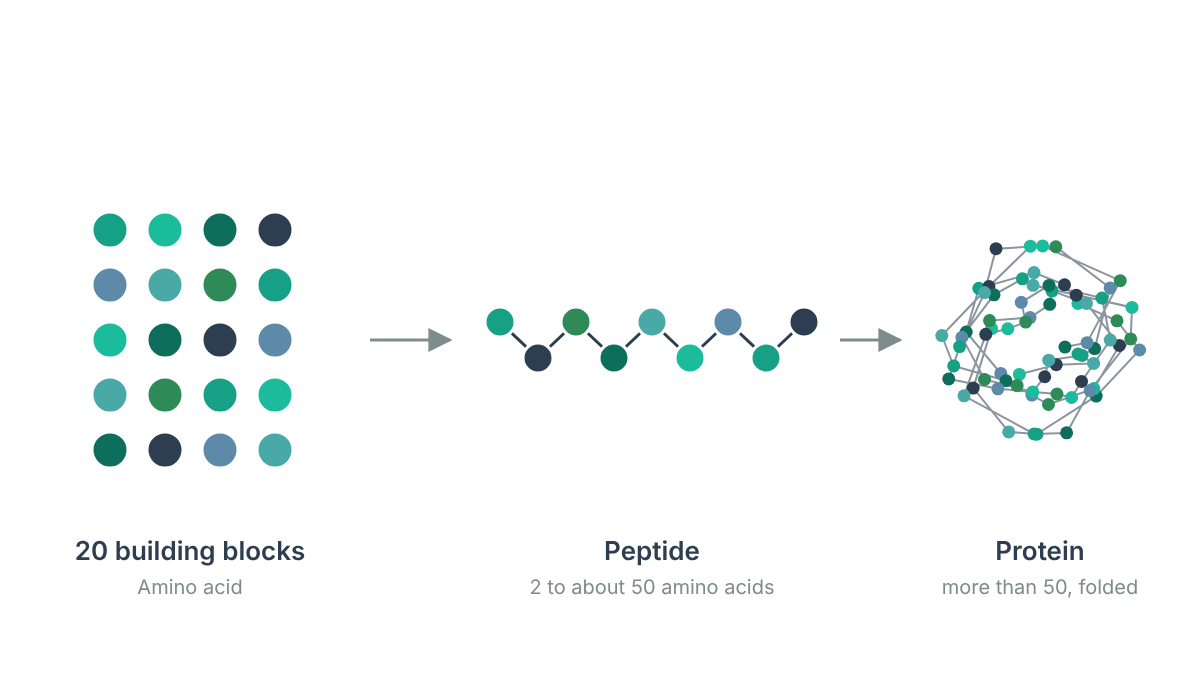
Peptides are short chains of amino acids. They are the same twenty building blocks of which all the proteins in our body are made. The difference lies in the length. Up to about fifty amino acids we speak of a peptide; longer chains that fold into a fixed shape are called proteins.
What task a peptide has depends solely on the order of its building blocks. Oxytocin consists of nine amino acids, insulin of fifty-one. If a single building block changes, a completely different substance can result.
Messengers with an exact address
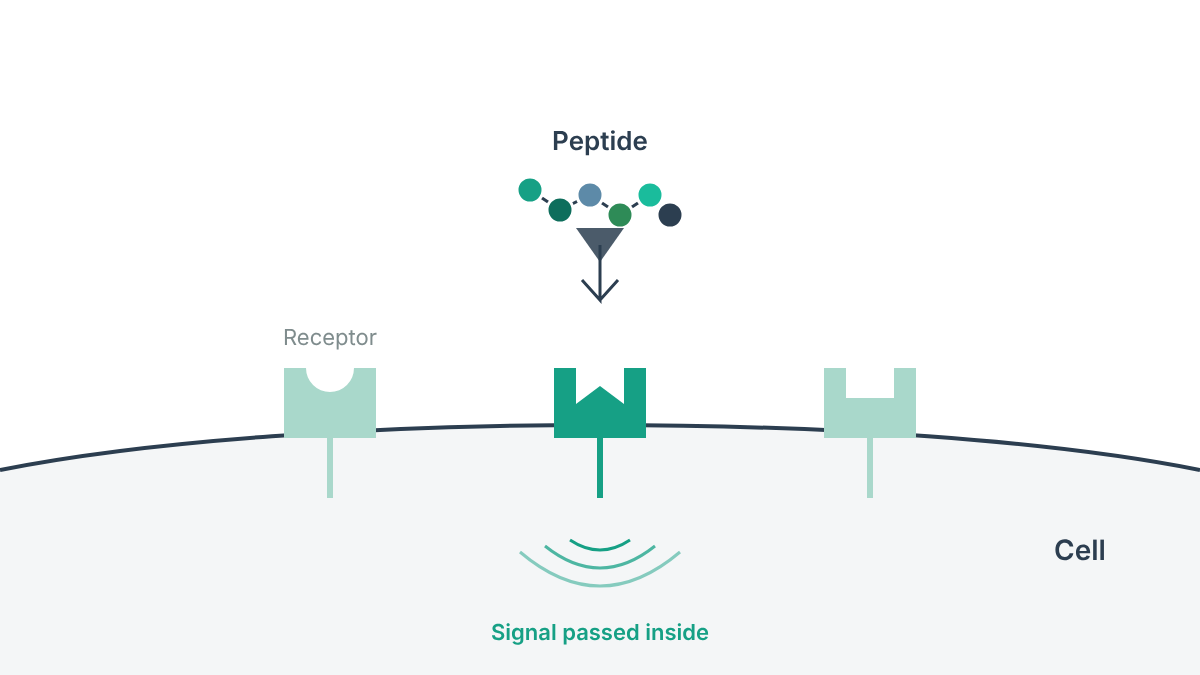
The body makes peptides itself and uses them as messengers. A peptide reaches a cell and docks onto a receptor that fits it exactly, like a key in its lock. The cell then passes the signal inside. It may be about growth, the healing of tissue, defence, sleep or the handling of inflammation.
Because the fit is so precise, tiny amounts are enough. A peptide addresses its cells and leaves the others alone.
Why medicine relies on peptides
Since insulin was first given to a person in 1922, peptides have been a growing field of medicine. More than eighty peptide drugs are approved worldwide today, and many more are being tested. They include the newer drugs that mimic the body's own gut hormone GLP-1.
The reason is always the same. Peptides are familiar to the body, and they act in a very targeted way. Therein lies the hope of many researchers.
From weight to frequency
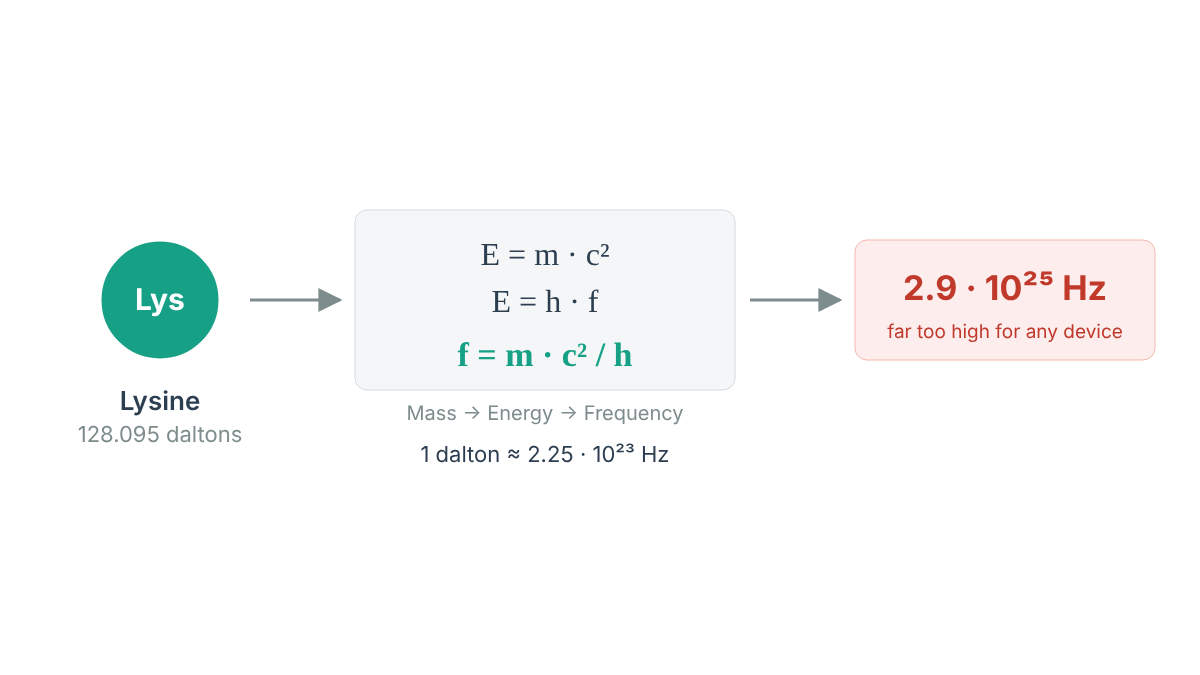
In frequency work a peptide is not taken in. It is transmitted as a sequence of frequencies. How do you get from a molecule to a frequency?
Every amino acid adds a precise weight to the chain. For lysine it is 128.095 daltons. According to Einstein every mass corresponds to an energy (E = m · c²), and according to Planck every energy corresponds to a frequency (E = h · f). Setting the two equal, every mass has a frequency, f = m · c² / h. For a single dalton that is about 2.25 · 10²³ hertz. This is also how it appears in the physical constants of the American measurement institute NIST.
For lysine this gives about 2.9 · 10²⁵ hertz. This frequency is unimaginably high; no device in the world can produce it.
The weights of the twenty building blocks
This is how much each amino acid weighs in the chain, in daltons. Leucine and isoleucine weigh the same.
Glycine: 57.021 Alanine: 71.037 Serine: 87.032 Proline: 97.053 Valine: 99.068 Threonine: 101.048 Cysteine: 103.009 Leucine and isoleucine: 113.084 Asparagine: 114.043 Aspartic acid: 115.027 Glutamine: 128.059 Lysine: 128.095 Glutamic acid: 129.043 Methionine: 131.040 Histidine: 137.059 Phenylalanine: 147.068 Arginine: 156.101 Tyrosine: 163.063 Tryptophan: 186.079
The same tone, many steps lower
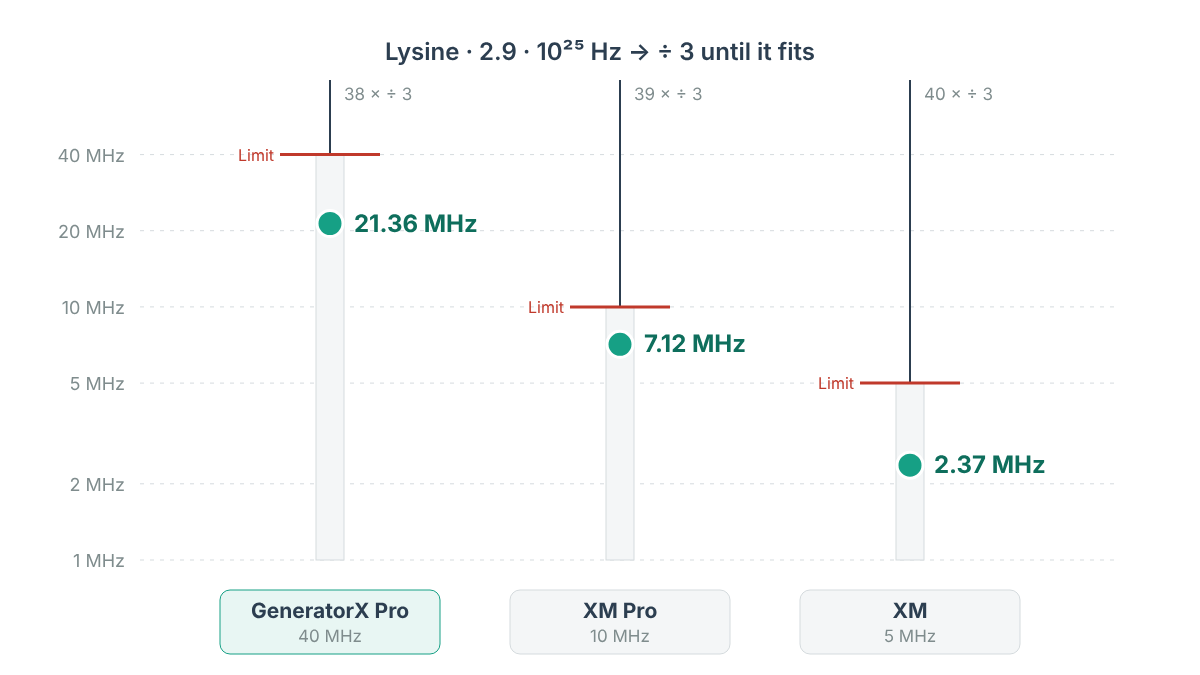
That is why the Spooky2 software divides the frequency by three as often as needed until it fits the range of the generator. Each division yields a lower undertone that stands in a fixed ratio to the original frequency.
On the GeneratorX Pro, which reaches up to 40 megahertz, lysine lands at 21.36 megahertz after 38 divisions. A device with 10 megahertz needs one more division and arrives at 7.12 megahertz, one with 5 megahertz at 2.37 megahertz. The higher a generator reaches, the less needs to be divided and the closer the frequency stays to its origin. That is why we usually run peptides on the GeneratorX Pro.
A peptide as a melody
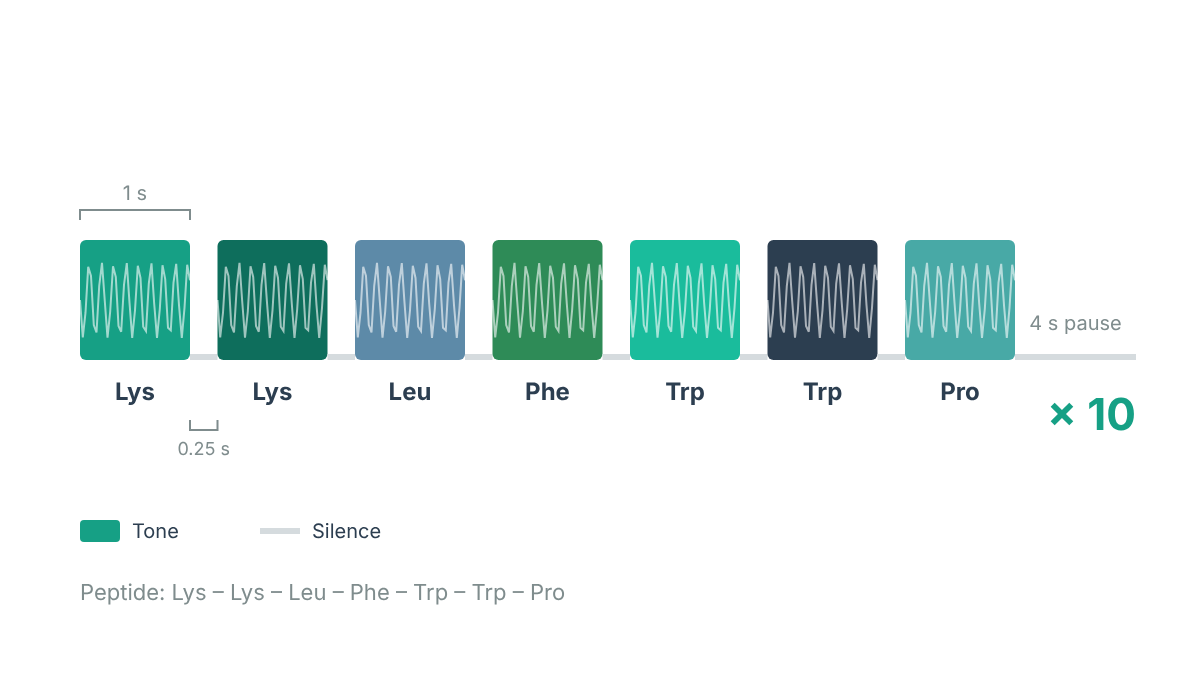
A peptide program is the order of its amino acids, translated into frequencies. Each amino acid sounds for one second, with a quarter of a second of silence in between. At the end of a peptide there are four seconds of pause. Each program runs ten times in a row, then the next follows.
This creates a kind of melody of very high tones that traces the structure of the peptide building block by building block. A preset may consist of a single peptide or of many. Some last twelve minutes, others almost an hour.
Short pulses instead of a steady tone
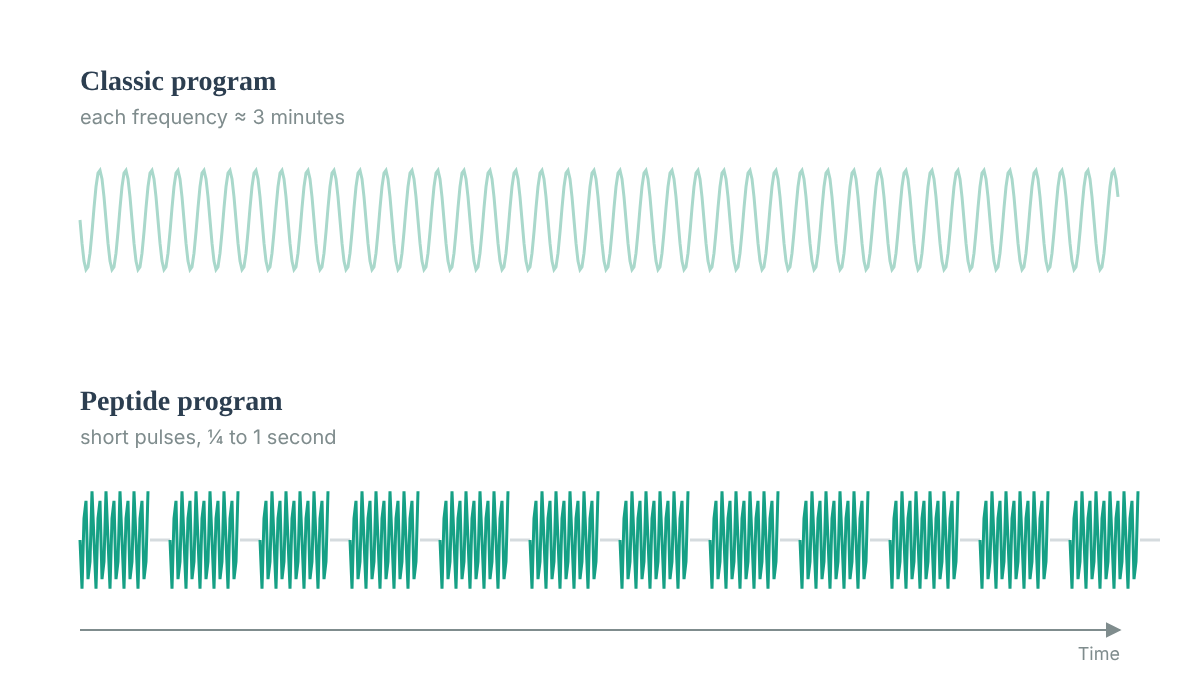
This is where peptide programs differ from classic Rife programs. There each frequency runs as a steady tone, usually for about three minutes. With peptides they are short pulses. The waveform is different too, a modulated square wave that brings even and odd overtones alongside the base tone. More on this in the article “Not all waves are the same”.
How we work with them
The peptide presets were developed over more than eight years under the direction of John White, the founder of Spooky2, and his research team, with a great deal of feedback from the community of users. Each preset relates to a specific peptide of the body and the signalling pathways in which it is involved.
We choose the peptide programs according to a person's topic, in the initial conversation and after the case history. What is transmitted are frequency signatures, not substances. Nobody takes anything. The programs run around the clock and accompany medical treatment; they do not replace it.
Sources
- NIST: CODATA-Werte der physikalischen Konstanten, «atomic mass unit-hertz relationship» 2,252 342 721 85 · 10²³ Hz
- L. Wang u. a.: Therapeutic peptides: current applications and future directions. Signal Transduction and Targeted Therapy 7, 48 (2022)
- Eigene Auswertung der Spooky2-Software und Messung am Oszilloskop, 17./18.10.2026
Peter A. Giger
Articles ›