The Oranges of Bordeaux
· by Peter A. Giger · 7 min read
A radio technician from Trieste builds a glowing tube in Bordeaux. For fourteen years, the Académie des sciences in Paris publishes experimental results about it, ministries fund the research, professors vouch for him. Then everything is forgotten. The story of Antoine Prioré.
A Prisoner of War Stays
Antoine Prioré was born in 1912 in Trieste, then a port city on the edge of Austria-Hungary, later Italian. He learnt radio technology and served in the Italian Navy. In 1944 he was taken prisoner and ended up in Bordeaux.
After the war he did not return. He stayed in France, married and opened a workshop for radios and electrical appliances. On the side, he built high-frequency transmitters. He was not a doctor or a professor, but a tinkerer with a particular feel for radio technology.
MoreLess
The period in which Prioré sets up his workshop is a time of new beginnings. Radio, radar and high-frequency technology had developed rapidly during the war. All over Europe, technicians are experimenting with tubes, coils and transmitters, many of them in small workshops. Prioré is one of them. What sets him apart is the question he soon asks himself: What do these fields do to living tissue?
The precise dates of Prioré's life are not entirely consistent in the literature. The most important source on his life is the book by the Frenchman Jean-Michel Graille from 1984.
Oranges That Do Not Rot
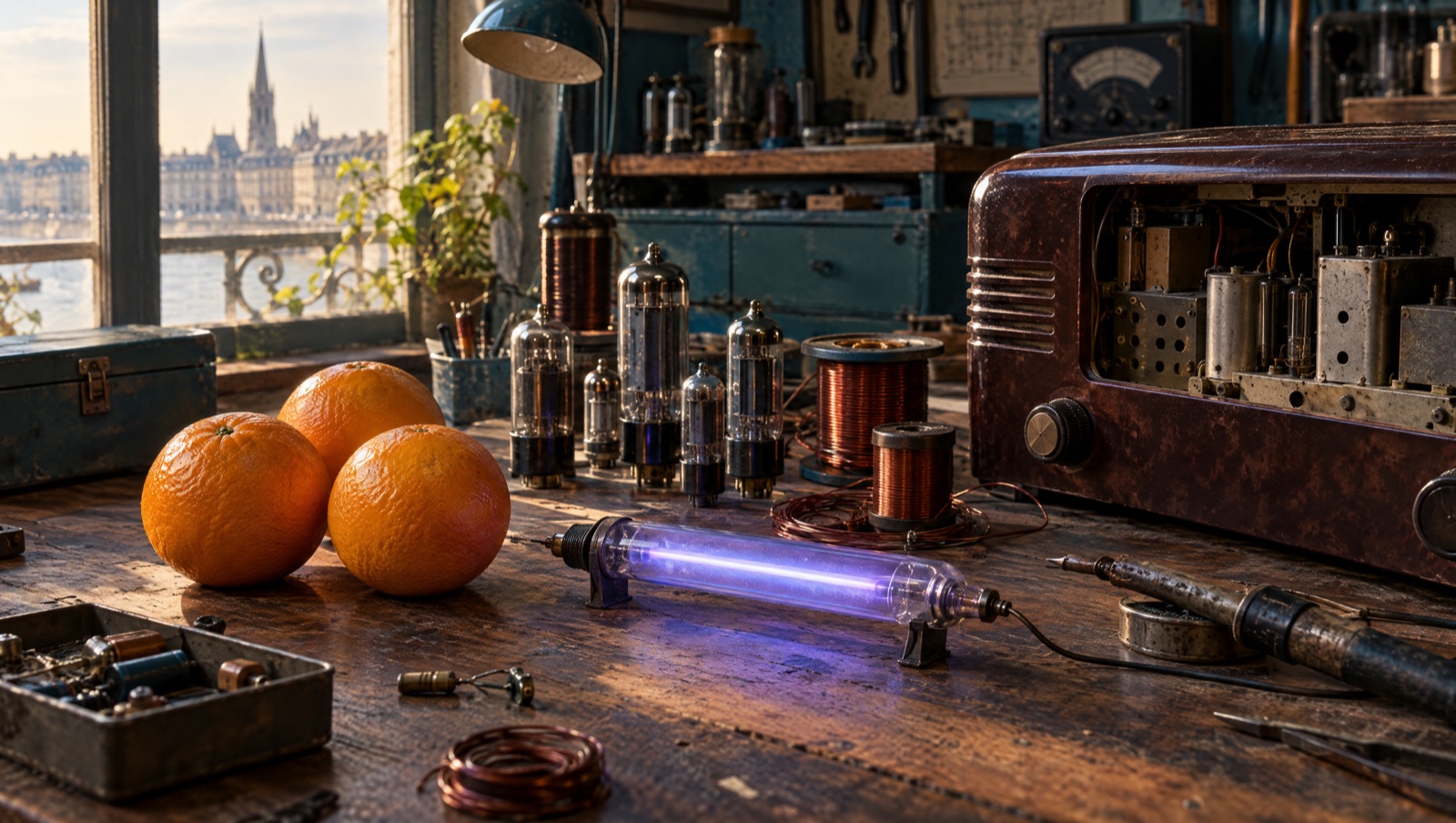
According to Prioré's own account, it all begins with an observation: oranges lying near his equipment do not rot.
Prioré wants to know why. What starts as tinkering becomes a life's work. He begins to observe the effect of his transmitters on living organisms. Soon he seeks contact with scientists in Bordeaux.
MoreLess
Whether the story with the oranges happened exactly like that can no longer be verified today. It comes from Prioré himself. Such origin stories exist for many inventors. Above all, they show what drove people: an unexpected observation and the persistence to pursue it.
What is remarkable is how seriously the scientific community soon took Prioré. A radio technician from a small workshop gained access to professors at the University of Bordeaux and eventually to the Académie des sciences in Paris, one of the most respected scientific institutions in Europe.
The Glowing Tube
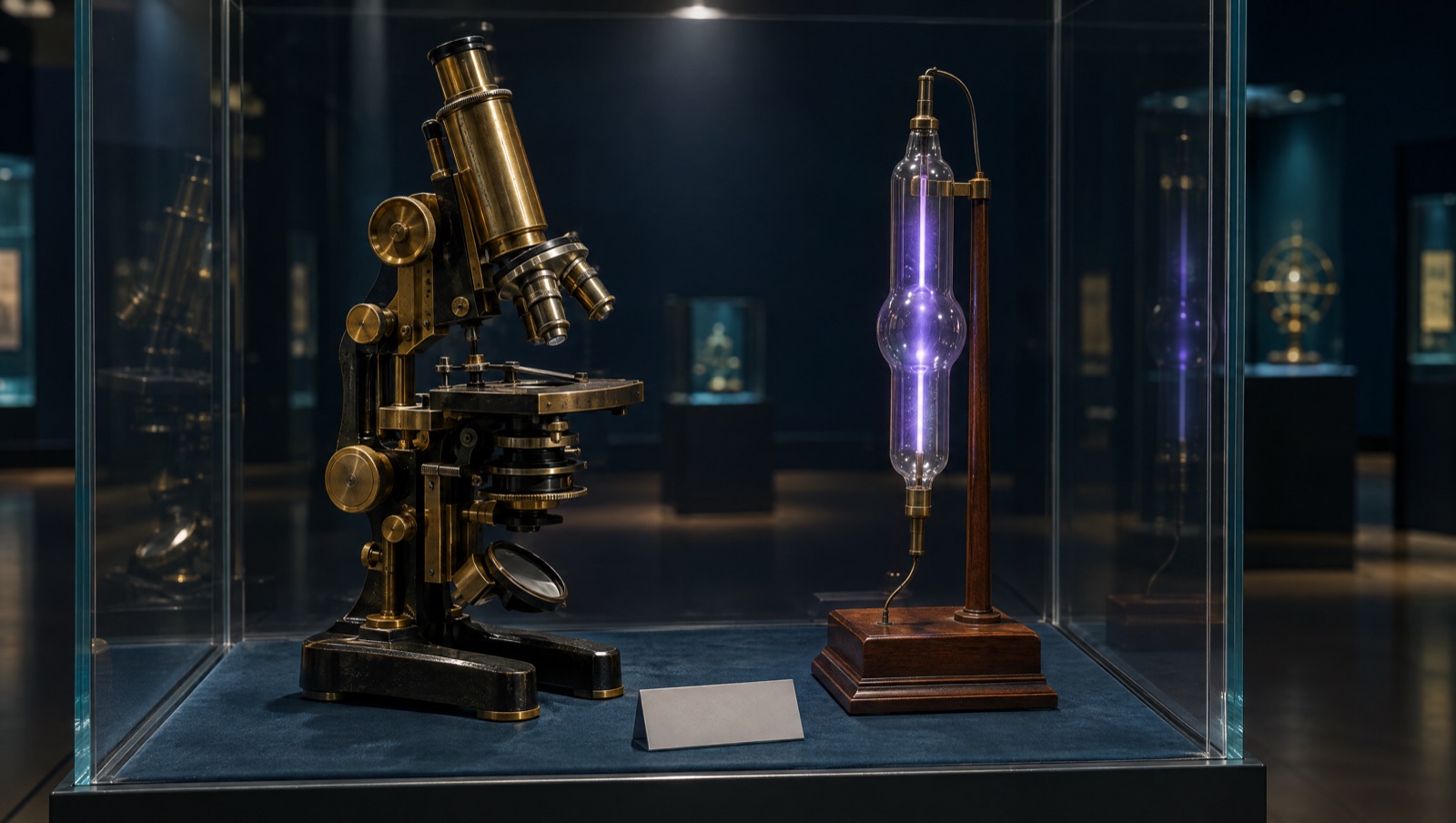
At the heart of Prioré's devices is a tube with a mixture of mercury vapour and noble gas, in which a plasma glows. Strong magnetic fields surround the tube. Into the plasma, Prioré radiates high frequency, which he modulates with low frequencies. The experimental animals lie beneath the tube.
Later measurements show: the devices produce no X-rays, and they do not heat the tissue noticeably. What they emit are pulsed electromagnetic fields across a broad frequency band, up into the microwave range, but at very low levels.
MoreLess
Prioré built several devices over the years. The early machines were created in the fifties and sixties. In 1975 a renewed machine, the P5, was tested. Eventually a large-scale installation spanning several floors, the M-600, was planned. It was never completed.
The fact that the fields are so weak is important. An effect cannot simply be explained by heat, as with a microwave oven. If the experimental animals react to the fields, then to something other than heat. That is precisely what made the results so puzzling for the scientists.
Prioré also applied for a patent for his method. In the USA he received patent 3 280 816 in 1966 with the title 'Method of Producing Radiations for Penetrating Living Cells', along with French patents for the method and device.
Paris Listens
From 1964 onwards, short technical reports, so-called notes, about experiments with Prioré's device appear regularly in the Comptes rendus of the Académie des sciences. They are presented by Robert Courrier, a respected endocrinologist and permanent secretary of the Academy. On 1 March 1965, Courrier even presents such a note in a public session.
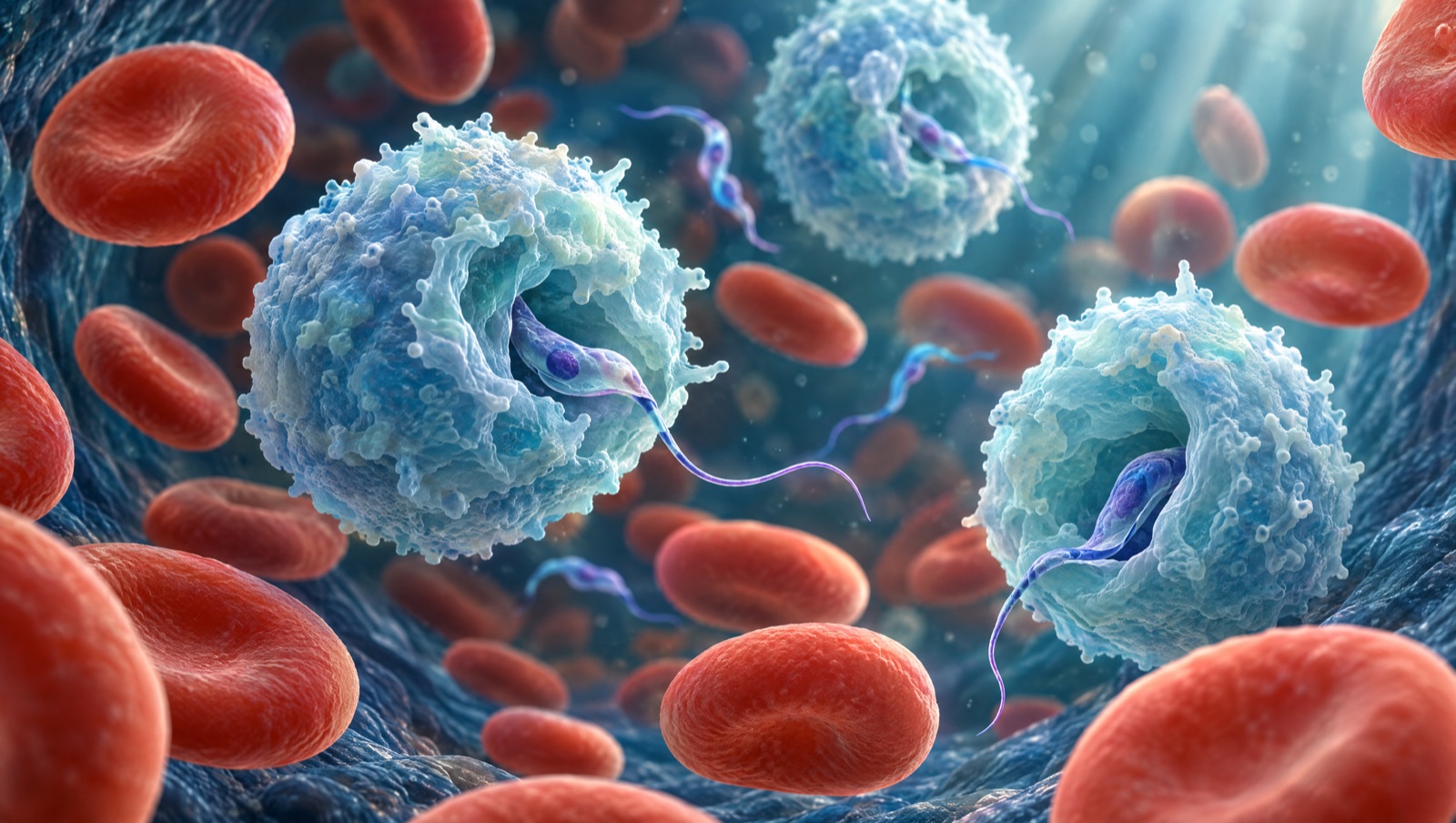
Initially it concerns tumours in rats and mice. From 1966 onwards, Raymond Pautrizel, Professor of Parasitology and Immunology at the University of Bordeaux, takes over the main work. He investigates how animals with an infection by trypanosomes, single-celled parasites, react to the fields.
MoreLess
The Comptes rendus are the Academy's house journal. A note in it is not a long essay, but a brief report often only four pages long. For a note to appear, a member of the Academy must present it and thereby vouch for it to some extent.
Between 1964 and 1978, around a dozen notes on Prioré's fields appear. The first, by Marcel-René Rivière and Marcel Guérin, concern tumours in rats and mice. From August 1966 onwards follow the works of Raymond Pautrizel and his colleague Anne-Noëlle Pautrizel on trypanosomes, plus in 1969 a work on lipid metabolism in rabbits and in 1972 one by Gaston Mayer on inflammation caused by trypanosomes in rabbits.
All volumes of the Comptes rendus are now freely accessible in full text on Gallica, the digital library of the French National Library.
What emerged from the experiments is told in our article 'Not the Pathogen, but the Defence'.
Who Paid for the Research?
The experiments cost money, and it came from the state. France's civilian research funding body, the DGRST, supported the work. Later, through a contract with the electrical company Leroy-Somer, it also financed the construction of the new P5 machine.
The Ministry of Defence was also involved. Its research fund, the DRME, received a final report from Pautrizel in 1972 and was co-commissioner of an inspection report from 1971.
MoreLess
The DRME, the Direction des recherches et moyens d'essais, broadly funded basic research in the sixties and seventies, comparable to the American DARPA. Why it was interested in Prioré is not explicitly documented in the accessible records.
Two reasons are plausible. Trypanosomes are the pathogen family of sleeping sickness, and French troops were stationed in Africa at that time. A method that strengthens defence against such infections would have been valuable to the military. Additionally, during the Cold War many states researched how electromagnetic fields affect living organisms.
This is an interpretation, not proof. What lies in the military archives about Prioré's devices has not been published to this day.
The 1971 inspection report was written by two of France's most renowned physicians: the haematologist Jean Bernard and the radiobiologist Raymond Latarjet from the Institut Curie. It went to the CNRS and to the DRME.
The Secret
Prioré has one great flaw: he shows no one how his device is built inside. Circuit diagrams and settings remain secret.
For science, this is a serious problem. A result is only considered secure when others can independently reproduce it. Parisian scientists therefore demand that the experiments be repeated in another laboratory with a second machine. But without blueprints there is no second machine.
MoreLess
There were attempts to reproduce the effect with other devices. In May 1966 Pautrizel tested a comparison device from the SERESO company. It produced only partial results. From October 1976 A. Bellossi in Rennes worked with his own magnetic fields on infected rabbits.
The basic experiment with the trypanosomes, however, only succeeded with Prioré's own device. For the critics, this was a sign that something could not be right. For the supporters, it was an indication that the particular combination of plasma, magnetic field and modulation was crucial, which simpler devices did not achieve.
Why Prioré remained so secretive is not entirely clear. Perhaps he feared that someone would take his invention away from him. Perhaps he himself did not fully understand which setting made the difference. What is certain is that his secrecy ultimately did more harm than good to the cause.
The P5 and the End
In February 1975 the new P5 machine is tested on over 280 infected mice. Shortly afterwards it is largely destroyed during modifications through misoperation. The planned large-scale M-600 installation spanning several floors is never completed.
Prioré suffers a stroke. Funding ends. In 1983 he dies in Bordeaux. His machines fall into decay.
MoreLess
The years after 1975 are a story of gradual decline. Pautrizel publishes an overview of all experiments with trypanosomes in 1977 and in 1978 another note on the influence of the age of experimental animals. A DGRST mission under Stratis Avraméas accompanies the project until 1981.
Without a functioning machine and without an inventor who could have built it anew, there was no longer any way to clarify the open questions. That is perhaps the bitterest irony of the story: the results were never disproved, but also never confirmed. They simply remained unresolved.
What Remains
The 'Affaire Priore', as it is known in France, is still considered unresolved to this day. What remains are around a dozen specialist notes in one of France's most respected journals, an American patent and a book by Jean-Michel Graille entitled 'Le dossier Priore. Une nouvelle affaire Pasteur?'.
The story shows why science needs openness: what no one can rebuild, no one can confirm.
MoreLess
Prioré is not entirely forgotten. A working group on Wikibooks has compiled a detailed dossier with timeline, experiment descriptions and the inspection report by Bernard and Latarjet. One of its members, William Ellison, and the French association Pot d'Argile continue to work through the documents. They have even filed new patents based on Prioré's fields.
The subtitle of Graille's book alludes to Louis Pasteur, who initially met with much resistance with his ideas about microbes. Whether Prioré was an unrecognised pioneer or an inventor who became entangled in his own secret, no one can say for certain today. His story remains an invitation to look closely and remain open.
Sources
- Jean-Michel Graille: Le dossier Priore. Une nouvelle affaire Pasteur? Paris 1984
- Comptes rendus de l'Académie des sciences, 1964–1978
- Dossier «Affaire Priore», Wikibooks (französisch)
- Affaire Priore, Wikipedia (französisch)
- Antoine Prioré: US-Patent 3 280 816, Method of Producing Radiations for Penetrating Living Cells, 1966
- Jean Bernard, Raymond Latarjet: Rapport de synthèse, 1971
Peter A. Giger
Articles ›