Rife's Tube in the Museum
· by Peter A. Giger · 5 min read
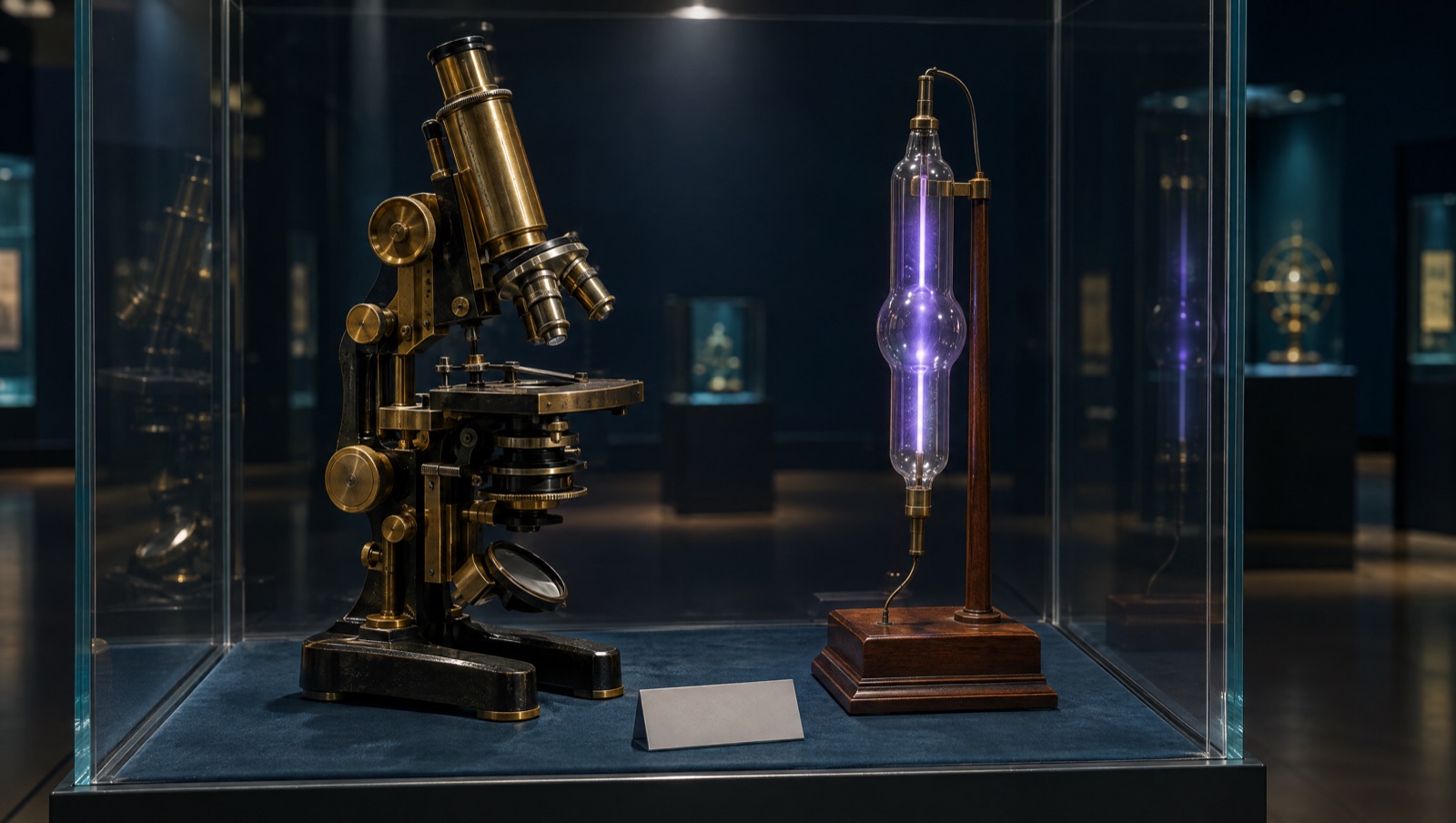
The Science Museum London holds a glass tube from 1938 and a microscope numbered 5. They belong to one of the best-known stories in frequency work: the story of Royal Raymond Rife, his luminous tube and a clinical trial whose records were lost.
The Man from San Diego
Royal Raymond Rife (1888–1971) lived and worked in San Diego, California. He first became known for his microscopes. He built them himself and wanted to observe pathogens with a precision that was hardly possible for anyone at the time.
From this work emerged an idea that never left him: every pathogen has its own frequency at which it is damaged. Rife called it the 'mortal oscillatory rate'.
MoreLess
The idea is easier to understand if you think of a wine glass. When a singer sings exactly the right note, the glass begins to resonate. If the note becomes loud enough, the glass can shatter, whilst other objects in the room remain untouched. Rife believed that microorganisms also have such a resonant frequency and that one could target them specifically without damaging the surrounding tissue.
To find these frequencies, Rife observed the pathogens under the microscope and exposed them to various frequencies. At least, that is how it has been passed down: he noted at which frequencies they changed or stopped moving.
A well-known photograph from the Smithsonian Institution archives shows Rife together with the physician Arthur Kendall at one of his microscopes. Kendall was one of the medical practitioners who took an interest in Rife's work at the time.
How the Tube Worked
For his frequencies, Rife needed a transmitter. He chose a glass tube filled with helium, later with argon. A high frequency made the gas luminous, as plasma, similar to a neon sign.
This high frequency served as a carrier. Onto it, Rife impressed the lower frequencies that he had found under the microscope. The tube hung above the patient and did not touch them.
MoreLess
The principle of a carrier and an impressed frequency is familiar to everyone from radio. A radio station transmits on a high frequency, about 100 megahertz. The music, which has much lower frequencies, is impressed onto this carrier wave. The radio in the living room separates the music from the carrier again.
Rife used the same principle. The high frequency made the gas luminous and carried the fields into the room. The impressed lower frequencies were the actual vibrations that mattered to him.
Why specifically a plasma tube? A luminous gas conducts electricity and thus acts like an aerial. When the current is switched off, the tube becomes an ordinary glass tube again. More about this particular state of matter can be found in the article 'Plasma – the Fourth State'.
The 1934 Trial
In 1934, sixteen sick people came under Rife's tube at a clinic near San Diego. The trial was supervised by a committee from the University of Southern California under Milbank Johnson.
Each session lasted three minutes, every three days, over three months. The records of this trial have been lost. That is why it cannot be verified to this day what exactly happened.
MoreLess
Many stories surround this trial. In the literature about Rife, especially in the book 'The Cancer Cure That Worked' by Barry Lynes from 1987, it is described as a great success. However, because the original records are missing, these accounts cannot be verified against the documents from that time.
This is a considerable loss for the history of frequency work. A trial supervised by a university would have been a valuable source. As it is, only what was later recounted and written down remains.
Beam Ray and the End
In 1938, Rife founded the Beam Ray Corporation with the engineer Philip Hoyland to build the devices in greater numbers. In doing so, Hoyland modified the circuit.
In 1939, there was a lawsuit, and production ended. Rife lived for over thirty more years and died in 1971.
MoreLess
Hoyland's modification of the circuit continues to occupy the frequency community to this day. Spooky2, the manufacturer of the devices we work with, attributes the fixed high-frequency carrier not to Rife himself, but to Hoyland.
For this reason, the Spooky2 Central plasma device works without a fixed carrier. It has a helium-filled tube, which is a replica of Rife's tube, and a straight tube with argon for the whole body. These are specifications from the manufacturer.
Whether Rife's or Hoyland's circuit was the better one can no longer be decided today. However, the discussion shows how alive Rife's legacy has remained.
The Path to the Museum
A doctor had purchased a tube device from 1938 and microscope No. 5 from Rife. Via the London School of Hygiene and Tropical Medicine, both pieces came to the Science Museum London in 1990.
Today they belong to the collection of the Science Museum Group. Thus they are tangible witnesses to a story that otherwise consists mainly of accounts.
MoreLess
That Rife's devices ended up in London of all places has to do with this chain of owners. The London School of Hygiene and Tropical Medicine is one of the best-known institutions for tropical medicine. It did not keep the pieces but passed them on to the museum.
For the history of frequency work, these objects are valuable. There are many books, websites and stories about Rife, but few things that one can actually look at. The tube from 1938 shows how a device from the time of the Beam Ray Corporation was built. The microscope shows the tools with which Rife made his observations.
Photographs of the objects can be found in the online collection of the Science Museum Group.
What Has Become of It Today
Modern frequency generators usually work differently from Rife's tube: via electrodes, hand cylinders, pads or as remote application via a personal sample. However, many frequency lists used today still bear Rife's name.
And the plasma tube itself has also returned. Plasma devices transmit the frequencies without contact via a luminous tube into the room, just as in Rife's time.
MoreLess
Anyone who wants to understand where frequency work comes from cannot avoid Rife. This also includes saying openly how much of it is documented and how much is not. Documented are his devices, his microscopes, the Beam Ray company and the 1939 lawsuit. No longer verifiable are the results of the clinical trial from 1934.
Frequency work provides support. It is not a promise of healing and does not replace medical examination. At Frequentia Viva, plasma is one of three ways of application, alongside the classical work with the frequency generator and the scalar field.
Sources
- Barry Lynes: The Cancer Cure That Worked. 1987
- Science Museum Group Collection: Rife-Röhre und Mikroskop Nr. 5
- Smithsonian Institution Archives: Rife und Kendall mit dem Rife-Mikroskop, Image No. SIA2008-4734
Peter A. Giger
Articles ›