How vibration became visible: from Chladni to Rife
· by Peter A. Giger · 3 min read
In 1787 Ernst Chladni scattered sand on a metal plate and drew a violin bow along its edge. What happened next is part of the prehistory of frequency work.

Sand on a plate
Ernst Florens Friedrich Chladni was born in Wittenberg in 1756. He had studied law, but he was drawn to music and physics. His best-known discovery is easy to repeat. You take a thin metal plate, scatter fine sand on it and draw a violin bow along the edge.
As soon as the plate begins to sound, the sand starts to move. It wanders away from the places that vibrate strongly towards the lines where the plate is at rest. After a few moments a pattern lies there, often of astonishing order. Every tone draws its own picture. A higher tone produces a finer, more branched pattern.
Chladni described these sound figures in 1787 in his book “Entdeckungen über die Theorie des Klanges” (Discoveries in the Theory of Sound). For the first time one could see what until then one could only hear.
A prize from Paris
In 1808 Chladni showed his figures in Paris to members of the Academy of Sciences. Napoleon watched too. He endowed a prize for whoever could explain the behaviour of vibrating plates mathematically.
It took years before anyone found an answer. The mathematician Sophie Germain submitted work several times and received the prize in 1816. Her treatise on the vibration of elastic surfaces is regarded as one of the beginnings of the theory of elasticity. Chladni himself is still called the father of acoustics today.
What resonance means
Behind the sound figures lies a basic law of physics. Every body has frequencies at which it readily vibrates of its own accord, its natural frequencies. If a vibration meets it exactly in this rhythm, it responds strongly. At all other frequencies it stays almost still.
This can be observed in everyday life. A guitar string sounds along when the same note is played nearby. A glass hums at a certain tone. This is called resonance. Chladni's plate shows it as a picture.
Royal Raymond Rife
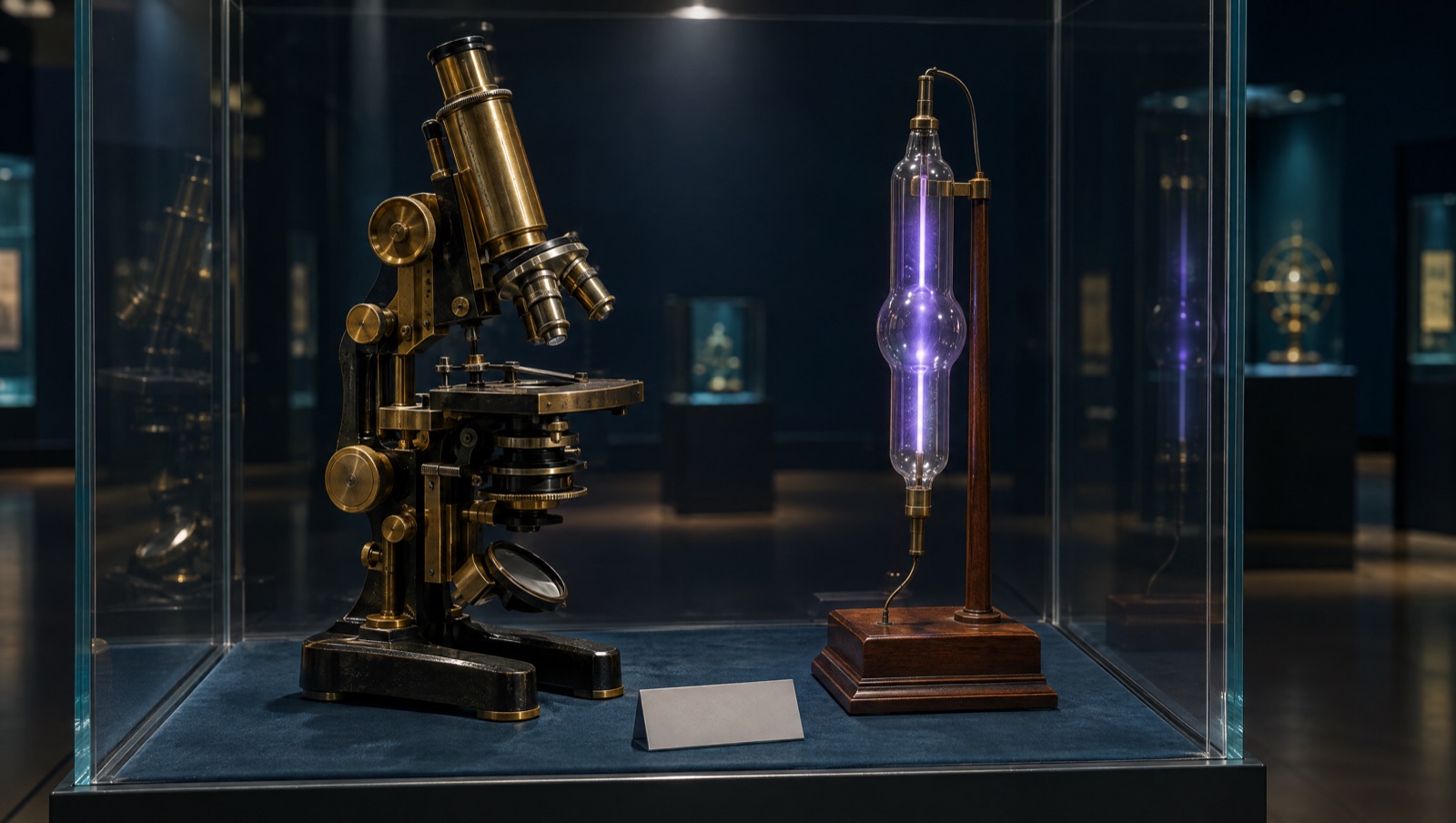
A good hundred years after Chladni's book, in 1888, Royal Raymond Rife was born in Elkhorn in the American state of Nebraska. In the 1930s he built light microscopes of unusual design in San Diego. With special light and polarising filters they made the tiniest living things appear in their own colours without having to stain them. In this way Rife could observe them alive.
From these observations he developed an idea that follows the principle of resonance. Every microorganism, he held, has its own frequency at which it cannot persist. Rife called it the “Mortal Oscillatory Rate”. He searched for these frequencies one by one and recorded them.
In 1931 the journal “California and Western Medicine” published a report he had written together with the bacteriologist Arthur I. Kendall. The 1944 annual report of the Smithsonian Institution also mentioned his microscopes. The medicine of his time did not adopt his assumptions. Rife died in California in 1971.
What has remained
Rife's frequencies were written down, passed on and added to over the decades. From them and from many later collections came the frequency lists with which devices such as Spooky2 work today.
In the frequency work at Frequentia Viva these lists are one source among several. They are put together individually for each person and accompany medical treatment; they do not replace it. The idea behind them is old. It begins with a little sand on a plate and a bow that makes it sound.
Sources
- Ernst Florens Friedrich Chladni: Entdeckungen über die Theorie des Klanges. Leipzig 1787
- Ernst Chladni (Wikipedia, englisch)
- This Month in Physics History: Sophie Germain (American Physical Society, 2004)
- A. I. Kendall, R. R. Rife: Observations on Bacillus typhosus in its filterable state. California and Western Medicine 35 (6), 1931
- Royal Rife (Wikipedia, englisch)
Peter A. Giger
Articles ›