Plasma – the fourth state
· by Peter A. Giger · 11 min read
Solid, liquid, gaseous – everyone knows these from school. But there is a fourth state of matter, and it is the most common in the universe. A journey from the fire of ancient cultures through the aurora borealis and the glowing tubes of the frequency pioneers to plasma medicine today.

The fire that responds
Long before physics had a word for it, people saw more in fire than just heat. For the Greek thinker Heraclitus, the world itself was 'ever-living fire'. In ancient India, fire, Tejas, is one of the five great elements, and the very first hymn of the Rigveda is dedicated to Agni, fire. In China, fire is one of the five phases of transformation through which all living things pass.
The Bible also knows fire as a place of encounter: Moses sees a bush that burns yet is not consumed. At Pentecost, tongues as of fire appear above those gathered.
What connects these images: here, fire is not just something that destroys. It glows, it moves, it seems to respond. These are precisely the properties of what physics today calls plasma.
MoreLess
One example that directly connects tradition and physics is St Elmo's fire. During thunderstorms, bluish flames sometimes glow at the masthead of ships without anything actually burning. Sailors interpreted them as a good omen and named them after St Erasmus, their patron saint. Physically, St Elmo's fire is a glow discharge, in other words plasma: the high electrical voltage in the thunderstorm air strips electrons from air particles, and the gas begins to glow.
In the Andes, fire from the sky is still associated with healing today. Anyone struck by lightning who survives is considered to be called by the thunder god Illapa and is permitted to heal and prophesy. This was documented by the Spanish chronicler Polo de Ondegardo in the 16th century. The tradition lives on amongst the Paqos of the Quechua, whose highest healers, the Altomisayoq, have often been struck by lightning three times, and amongst the Yatiri of the Aymara. The ethnologist Juan Víctor Núñez del Prado described this in 1974.
Lightning itself is also plasma. For a fraction of a second, the air becomes so hot and so highly ionised that it glows and conducts electricity.
Solid, liquid, gaseous and then?
If you heat ice, it becomes water. If you heat water, it becomes steam. If you add even more energy to a gas, through heat or electric fields, electrons break free from the atoms. What remains are electrically charged particles flying freely about. The gas is ionised. This state is called plasma, the fourth state of matter.
What's important: plasma does not arise by itself. It always requires energy input, as heat as in the sun or as electricity as in a fluorescent tube. When the energy supply stops, electrons and atoms find each other again, and the plasma becomes ordinary gas once more.
MoreLess
Plasma has three properties that clearly distinguish it from an ordinary gas.
It glows. When free electrons are rebound to atoms or atoms are excited, they release energy as light. Each gas glows in its own colour: neon red-orange, argon violet-blue, helium pink. This is why neon signs glow in different colours.
It conducts electricity. Because the charges are freely mobile, electrical current can flow through the plasma. This is why one can 'ignite' a fluorescent tube with electricity.
It responds to magnetic fields. Charged particles are deflected by magnetic fields. A plasma can therefore be shaped, focused and guided with magnets. Fusion research uses this, and the same physics manifests in the sky as the aurora borealis.
The standard textbook on the subject is 'Introduction to Plasma Physics' by Francis F. Chen.
Plasma is everywhere
On Earth, plasma is rather rare: in lightning, in a candle flame, in the fluorescent tube, in the xenon headlamp. In the universe it is the reverse. More than 99 per cent of visible matter is plasma, according to NASA.
The sun is an enormous plasma sphere, around 5,500 degrees hot at the surface and around 15 million degrees at the core. From it constantly streams a current of charged particles into space, the solar wind. When it encounters the Earth's magnetic field, it is directed towards the poles. There it causes the upper atmosphere to glow: the aurora borealis is created.
MoreLess
That the aurora borealis is connected to the sun was still a bold idea around 1900. The Norwegian physicist Kristian Birkeland built a small model of the Earth for this purpose: a magnetised sphere that he called 'Terrella', little Earth. In a vacuum chamber he directed charged particles onto it. Around the poles of the sphere it began to glow, an aurora in the laboratory.
Birkeland concluded from this that streams of charged particles from the sun create the aurora borealis. Many experts remained sceptical. His idea was only confirmed decades later when satellites could measure the currents in space directly.
One person who fundamentally shaped the understanding of plasma and magnetic fields is the Swedish physicist Hannes Alfvén. He received the 1970 Nobel Prize in Physics for his work on plasma physics. Alfvén waves, oscillations that travel along magnetic field lines through a plasma, are named after him.
The ionosphere and the heartbeat of the Earth
Above our heads, too, lies a layer of thin plasma: the ionosphere, at roughly 60 to 1,000 kilometres altitude. There, the sun's radiation ionises the thin air.
Together with the Earth's surface, the ionosphere forms an enormous cavity that spans the entire Earth. Within it oscillate electromagnetic waves, excited by the lightning that strikes constantly everywhere in the world. The physicist Winfried Otto Schumann predicted these natural oscillations in 1952. The lowest lies at around 7.8 hertz and is today called the Schumann resonance. It is sometimes called the heartbeat of the Earth.
MoreLess
How does such a natural oscillation arise? One can imagine the space between the ground and the ionosphere like an enormous resonating body, similar to the body of a guitar. Both walls conduct electricity: below the ground and the sea, above the plasma of the ionosphere. Waves that fit exactly around the Earth reinforce themselves. If one divides the speed of light by the Earth's circumference of around 40,000 kilometres, one obtains about 7.5 hertz. Measurements show around 7.8 hertz, plus overtones at around 14, 20 and 27 hertz.
The Schumann resonance has long been measured and is observed worldwide. It lies in the same frequency range as certain brain waves, such as the alpha rhythm around 10 hertz. Whether and how this plays a role for living beings is debated. What is certain: without the plasma of the ionosphere, this cavity and its oscillation would not exist.
Glowing tubes: Rife and Prioré
Two pioneers of frequency work made plasma into a transmitter.
Royal Raymond Rife filled a glass tube with helium in San Diego in the 1930s, later with argon. A high frequency caused the gas to glow and served as a carrier. Onto this carrier Rife impressed lower frequencies that he had identified for specific pathogens under the microscope. The tube hung above the patient without touching them.
Antoine Prioré built tubes with mercury vapour and noble gas from the 1950s onwards in Bordeaux, surrounded by strong magnetic fields. He too radiated modulated high frequency into the plasma. From 1964 to 1978, the Académie des sciences in Paris repeatedly reported on trials with his devices.
MoreLess
Why plasma in particular? A tube with glowing gas is an antenna of a special kind. As long as it is ignited, the gas conducts electricity and radiates fields. When switched off, it is once again an ordinary glass tube. Moreover, the plasma responds to magnetic fields, as Prioré used them.
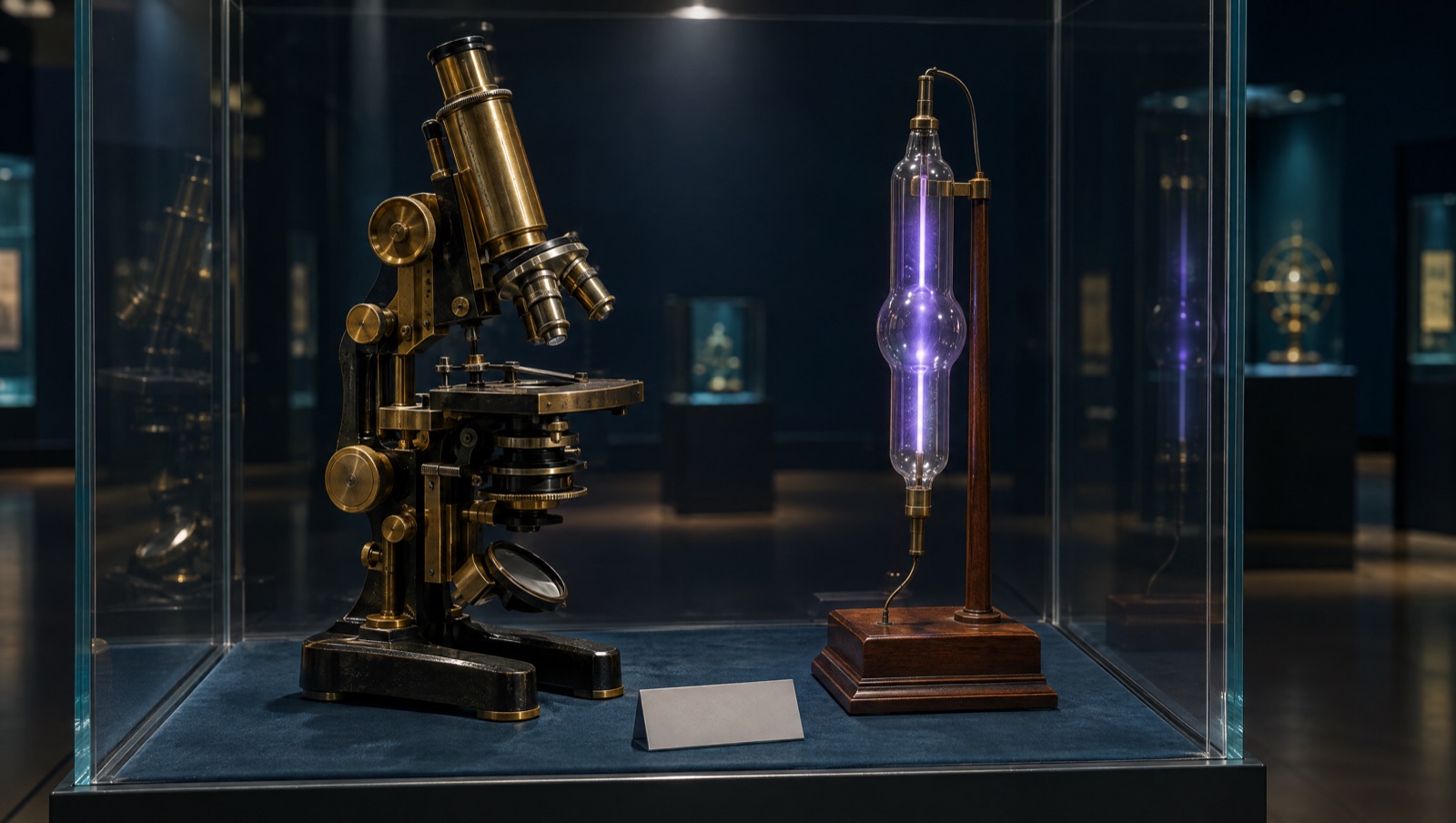
Rife's tube and his microscope No. 5 can be seen today at the Science Museum London. Rife's story is told in our article 'Rife's tube in the museum', Prioré's in the article 'The oranges of Bordeaux'.
With both pioneers much remains unanswered. Rife's files from the clinical trial of 1934 have been lost. Prioré kept the construction of his devices secret, and his machines have deteriorated. That is precisely why it is remarkable that modern medicine today is arriving at plasma again by a completely different route.
High frequency in Europe: d'Arsonval and the home devices
Europe had its own plasma history. In the 1890s, the French doctor and physicist Jacques-Arsène d'Arsonval introduced high-frequency currents into medicine. The technology for this went back to Nikola Tesla. Soon people spoke of 'd'Arsonvalisation'.
Between the two world wars, high-frequency home devices experienced their heyday. In a glass electrode with rarefied gas glowed a violet plasma, which is why they were called 'Violet Ray' in English. The advertising recommended them for many things, from skin complaints through colds and pain to serious illnesses.
MoreLess
Technically, these devices contained a spark-gap transmitter and a Tesla coil. They generated alternating currents of about 10 to 20 kilohertz and voltages up to around 40,000 volts. The glass tubes were built on the principle of the Geissler tube: the gas inside was under reduced pressure and glowed even with a small current.
In Germany alone there were many manufacturers. In Leipzig, Velmag built the 'Frequenta' and Richter & Mückenhaupt the 'Original Tufabor', in Dresden Knoke & Dressler built devices such as 'Radiolux' and 'Radiostat'. Additionally there were 'Helios', 'Phönix', 'Ultra' and others. The company Tefra in Berlin has been manufacturing such devices from the 1920s to the present day.
They were also widespread in Switzerland. The Museum Luzern houses a device from 1931 from Nuremberg that belonged to a woman from Willisau. In Zurich, Roland Beer has been building high-frequency devices again since 2009.
After the Second World War, home devices disappeared almost everywhere. With penicillin began the era of the large pharmaceutical industry. In the USA, the authorities proceeded against manufacturers in the 1940s and 1950s with lawsuits, recalls and confiscations. In Europe, the devices disappeared more quietly.
In clinics, however, high frequency remained. In 1923, the company Erbe in Tübingen built the first pure high-frequency surgical device. In 1928, Abraham Esau built the first shortwave device for medicine in Jena, and the doctor Erwin Schliephake made shortwave therapy known from 1930 onwards. From high-frequency surgery emerged argon plasma coagulation, with which bleeding is now stopped in many hospitals.
Plasma in medicine today
Today, plasma in medicine is experiencing a new beginning, this time as cold plasma. It is created at normal atmospheric pressure and is barely warmer than the skin, which is why it can be directed straight onto tissue.
Leading in this field is the Leibniz Institute for Plasma Science and Technology (INP) in Greifswald. In 2013, the plasma pen kINPen MED developed there received CE certification as the first cold plasma medical product in Germany, for chronic and infected wounds. Since February 2022, a guideline of the German medical societies (AWMF) recommends treating such wounds with cold plasma.
MoreLess
The plasma pen works with argon. The approval study took place at the Charité in Berlin under Jürgen Lademann. Cold plasma also works against multidrug-resistant germs such as MRSA and stimulates the formation of new tissue.
Meanwhile, research in Greifswald is also investigating whether cold plasma can help in cancer medicine. The studies are small and at an early stage. In 2015, doctors at Greifswald University Medicine reported on twelve people with far-advanced tumours in the head and neck area, for whom only palliation was possible. In half the cases, germs, odour and pain decreased. In 2018 followed a report on six patients, of whom in two the tumour partially regressed over months. Not everyone responds, and the researchers emphasise how early in the process one still is.
What is interesting is how the plasma might work. One aspect under discussion is that it draws the immune system's attention to the tumour cells. This is reminiscent of the trials in Bordeaux in the 1970s, in which Prioré's fields supported not the pathogens themselves but the body's defence. More on this in the article 'Not the pathogen, but the defence'.
The standard work on the subject is simply called 'Plasmamedizin' and was published by Springer in 2016, edited by Hans-Robert Metelmann, Thomas von Woedtke and Klaus-Dieter Weltmann.
Plasma in frequency work today
The tradition of the glowing tube also continues in frequency work. Plasma devices radiate the frequencies contactlessly into the room via a gas-filled tube and thus reach the whole body. At Frequentia Viva, plasma is one of the three methods of application.
One such device is Spooky2 Central. According to the manufacturer, it works from 100 kilohertz to 3.5 megahertz and offers, in addition to plasma, PEMF, ultrasound and contact.
MoreLess
Spooky2 Central has two tubes. The Phanotron tube is filled with helium and radiates in a focused manner. It is a replica of Rife's tube. The straight tube is filled with argon and intended for the whole body. According to the manufacturer, the field is strongest in the near range up to about 15 centimetres. The device is operated by a generator of the type XM Pro.
One special feature concerns the carrier. Rife's tubes worked with a fixed high frequency as a carrier, onto which the actual frequencies were impressed. Spooky2 does not attribute this fixed carrier to Rife himself, but to his later partner, the engineer Philip Hoyland. Spooky2 Central therefore works without a fixed carrier.
All information in this section comes from the manufacturer.
Assessment
Plasma is not a mysterious substance, but well-researched physics. It glows, conducts electricity and responds to magnetic fields. What we call plasma today, people have always admired: in fire, in lightning, in the aurora borealis.
The frequency pioneers Rife and Prioré worked with glowing tubes whose effect was never conclusively clarified. Modern plasma medicine takes a different, rigorously tested path and in doing so encounters questions that recall these pioneers.
Frequency work with plasma accompanies. It is not a promise of cure and does not replace medical examination.
Sources
- Francis F. Chen: Introduction to Plasma Physics and Controlled Fusion. Springer
- NASA Heliophysics
- W. O. Schumann: Über die strahlungslosen Eigenschwingungen einer leitenden Kugel, die von einer Luftschicht und einer Ionosphärenhülle umgeben ist. Zeitschrift für Naturforschung A 7 (1952)
- Metelmann, von Woedtke, Weltmann (Hg.): Plasmamedizin. Springer 2016
- Leibniz-Institut für Plasmaforschung und Technologie (INP), Greifswald
- Deutsches Hygiene-Museum Dresden, Sammlung Online
Peter A. Giger
Articles ›